What Did Using ââåperspectiveã¢ââ in Art Allow Renaissance Artists to Do?
Changes in fine art
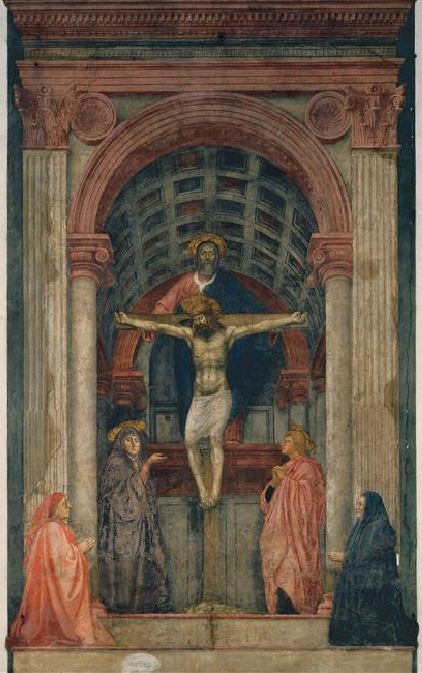
The Renaissance was too an artistic movement. In that location was a genuine revival in art during this menstruum. Styles varied considerably according to land, merely some common features can be noted: a search for realism; the apply of perspective; and the quest for low-cal, new techniques and fresh subjects. These are the innovations indicating the break with the art of the Heart Ages.
In search of realism
Art in the medieval period represented flat figures without volume, placed side by side on uniform backgrounds. The shapes and colours were more symbolic than real. For instance, the most important figure was bigger than the others. Renaissance artists were concerned about representing their scenes in a realistic style rather than co-ordinate to rules. Like the Greeks and Romans they admired, they set virtually studying the homo body by using alive models to accurately reproduce their proportions. They paid great attention to nature and incorporated their figures into landscapes.

Perspective
The new science of perspective gave the illusion of a 3rd dimension, emphasizing the realism of the scene. Painters would from now on utilize perspective with a single vanishing betoken to give depth to the work. Since Artifact painters had tried to create this effect but it was Brunelleschi who came up with the mathematical solution. The first to transfer this interest to architectural works was Masaccio. He painted a Trinity for the Santa Maria Novella church in Florence. The fresco'south scene seems to unfold inside a real chapel.
New techniques in painting
Painters did not buy tubes of paint only instead prepared their own colours based on pigments from plants and minerals. In the Heart Ages they crushed them finely with some egg white to make a paste. The material dried very apace! They had to paint rapidly and could not go back to a work. The Flemish painter Jan Van Eyck is said to have invented, or at least perfected, a new pictorial technique in the early 15th century: oil painting. He replaced the egg with oil. The paste then took longer to dry, so he had more time and could work with greater precision. Oil-based colours gave the paintings intense luminosity and made it possible to work with transparent layers.

Calorie-free
The Renaissance is ofttimes associated with a search for low-cal. It is found in painting as well as compages. Buildings were actually like fortresses with thick walls and narrow windows. Gothic churches softened these walls past calculation vaults and arches. The stained drinking glass windows immune coloured calorie-free to flood into the edifice. In the 15th and 16th centuries all the openings were enlarged. Large bay windows punctuated the facades to open the houses to the outside and permit light to penetrate. The system of organizing buildings into floors with regular openings is a model notwithstanding used today.
New themes
The arts would no longer restrict themselves to religious subjects. While these were all the same common, secular themes also began to announced. They show the important place given to human being during the Renaissance. Portraits became more widely used. Reading aboriginal texts prompted groovy patrons to commission paintings with mythological subjects. These myths were well-known in the Heart Ages, but they became very popular during the Renaissance. Sandro Botticelli, one of the greatest Florentine painters, was renowned for his huge mythological canvases. He sang the praises of beauty through their goddesses.

Source: https://www.grandpalais.fr/en/article/changes-art

Post a Comment for "What Did Using ââåperspectiveã¢ââ in Art Allow Renaissance Artists to Do?"